Breeding tank: how to set up a dedicated spawning aquarium
A dedicated breeding tank makes spawning 10× easier. What you need, how to set it up, what to avoid.
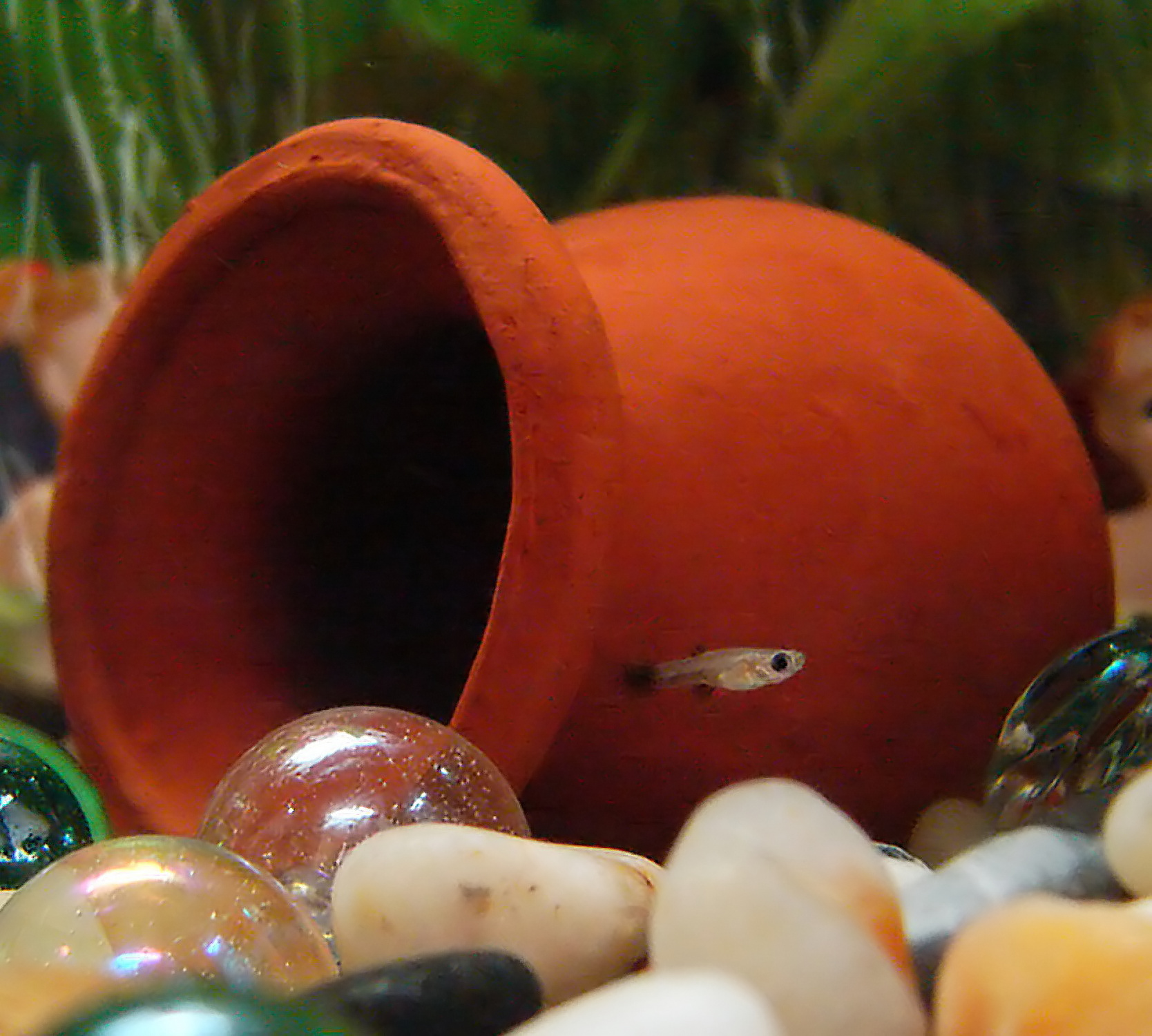
Breeding fish in a community tank is a lottery: 90 % of fry get eaten by tankmates or parents before you even notice them. A dedicated breeding tank changes the rules — controlled environment, no predators, targeted water parameters.
Why a separate tank
• Eggs and fry are safe from adult fish. • You can lower pH/hardness specifically for spawning without harming the main stock. • Easy to observe and feed fry with 'live dust'. • Easy to medicate prophylactically (methylene blue against egg fungus).
Size and shape
20–40 L is enough for most small species (tetras, rasboras, guppies, betta). Cichlids need 60 L+. A low, wide footprint beats a tall narrow one — more bottom area for spawning substrate.
Minimum equipment
Filter
Sponge filter on an air pump only. Internal and canister filters suck up fry and eggs. Pre-cycle the sponge in your main tank for 2–4 weeks so it's already colonised with bacteria.
Heater
25 W with an accurate thermostat. Temperature swings kill eggs faster than any predator. A backup thermometer is mandatory.
Lighting
Dim or none at all. Most species' eggs are light-sensitive; first-week fry are too. If you need light, keep it weak and ambient.
Substrate and decor
Bare bottom is easiest — fast to clean, uneaten food is visible. Alternative — a thin layer of fine sand. For spawning sites: Java moss, spawning mops (acrylic/wool yarn), a flat stone for cichlids, almond leaves for tetras.
Water parameters
Most tropical species spawn in soft, acidic water: pH 5.5–6.5, gH 2–6, kH 0–3. Achieved with an RO + tap mix plus peat extract or alder cones. Livebearers and cichlids — parameters per species.
Conditioning the breeders
For 2–3 weeks before spawning — keep males and females in separate tanks and feed heavily with live food (bloodworm, artemia, daphnia). This triggers egg development in females.
The spawning trigger
Most common — a 30–50 % water change with slightly cooler (–2 °C) and softer water (mimicking rainfall in nature) plus heavy live feeding. Many species spawn the very next morning.
After spawning
Two scenarios: • Egg-eaters (tetras, barbs) — remove parents immediately after spawning. • Caregivers (cichlids, gouramis) — leave them; they defend the eggs and fry. If eggs are clear with visible eye dots — fertilised; cloudy white — not, remove to prevent fungus.
Fry care
First 3–5 days — yolk-sac stage, they feed on it. Then: infusoria (cultured in a jar with a lettuce leaf), microworms, baby brine shrimp (hatch from cysts yourself). Feed 4–6× per day in micro-portions.
Water changes — 10 % every 2–3 days with a thin siphon (cocktail straw). Abrupt shifts kill fry.
What to avoid
• Internal filters — they swallow fry and eggs. • A freshly cycled tank — ammonia kills fry within 24 hours. • Overfeeding — leftovers rot and breed fungus on the eggs. • Bright lighting — stresses parents and kills eggs.
A breeding tank isn't a 'smaller aquarium' — it's a precision tool. The simpler and more stable, the higher the fry yield.
FAQ
- What size should a breeding tank be?
- 20–40 L is enough for most small species (tetras, rasboras, guppies, bettas). Cichlids and larger cyprinids need 60 L+. Discus need 100 L+ because they spawn on vertical surfaces.
- Can I breed fish in a community tank without a separate breeder?
- Technically yes, but fry survival is typically 1–5 % of those hatched. Eggs and fry get eaten by tankmates and the parents themselves. Exceptions: livebearers (guppies, mollies) in dense floating plant cover.

Goldie editorial team
Practising aquarists with a combined 30+ years of experience · Biologists and editors, fact-checking against FishBase and Seriously Fish · Every piece is reviewed by a qualified ichthyologist before publication

Senior aquarist, breeder, show judge
27+ years in aquaristics · Certified IAPLC judge (International Aquatic Plants Layout Contest) · Registered breeder of an Apistogramma agassizii line
Sources
- Seriously Fish — Breeding setups · Seriously Fish · 2026-05-22
- Aquarium Co-Op — Breeding fish · Aquarium Co-Op · 2026-05-22