Snail outbreaks: how to control the population
Snails aren't pests — they're an overfeeding indicator. How to identify them, control numbers, and stop new ones arriving on plants.
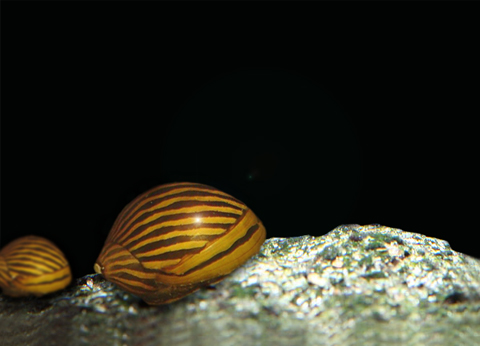
Suddenly the glass is covered with hundreds of tiny snails. This isn't an 'outbreak' — it's a feeding problem. Snails breed only to the level of available food. The goal isn't to wipe them out — it's to bring the population back into balance.
Snails that appear 'on their own'
Ramshorn (Planorbarius)
Spiral, flat shell 0.5–3 cm. Usually arrives on plants. Lays eggs on glass and leaves. Useful as a cleaner — a problem when there are hundreds.
Bladder snail (Physa)
Long pointed shell that slides even under the surface film. The most prolific: a single individual can produce 100+ offspring. Often the first to show up.
Malaysian Trumpet Snail (MTS)
Conical striped shell, lives in the substrate. Livebearer (no eggs on the glass). Beneficial — aerates the substrate. Becomes a problem only with severe overfeeding.
Why outbreaks happen
Main causes: • Overfeeding — leftovers become a snail buffet. • Young tank — biofilter not caught up, nitrates high, algae high. • Plants from a shop — a single trip seeds a tank. • A dead fish overlooked for days — enough biomass for a hundred new snails.
Manual removal
Lettuce trap
Blanch a lettuce leaf in boiling water (it goes limp), put it on the substrate at night. In the morning it's covered with 20–50 snails — remove and discard. Repeat 5–7 days — removes 60–70 % of the population.
Cucumber or zucchini trap
A piece of cucumber or zucchini weighted with a fork. Works like the lettuce but stronger attractant for larger snails.
Hand-picking
In the morning, the glass is covered with snails — collect by hand or tweezers. Don't flush — these are invasive species. Salt them and dispose in the bin.
Biological control
Assassin snail
A predatory snail that eats other snails. 5–8 assassins per 100 L will crush the population to invisible within 2–3 months. After that, feed them bloodworm or they starve.
Yoyo loach
A schooling loach (5+ individuals) that loves small snails. Downside: grows to 12 cm, needs 100 L+.
Pea puffer
Tiny predator 2–3 cm, aggressive to other fish but obsessed with snails. Best in a species-only tank or breeder — not for community.
What not to do
• Don't use molluscicides — toxic to plants, shrimp, and fish. Destroys the whole ecosystem, not just snails. • Don't try to eradicate completely — impossible. A small population is useful as an indicator and clean-up crew. • Don't kill them all in one go — the biomass of dead snails will poison the water.
Preventing new snails
Quarantine plants before planting: • Soak in alum solution (1 g/L) for 24 hours — kills eggs and adults. • Or 30-second bleach dip (1:19) followed by thorough rinsing. • Or 2–3 weeks in a quarantine jar without fish — snails will show themselves.
Roots and substrate from purchases can also carry eggs. After quarantine — rinse three times in clean water.
When snails are useful
• MTS — turn and aerate the substrate, especially with heavy root feeders. • Ramshorns — eat dying leaves and food scraps. • Any snail — an indicator: if numbers grow, you're feeding too much.
There's no 'snail outbreak'. There's a 'leftover food outbreak'. Cut feeding by 30 % and the snail population drops on its own in 4–6 weeks.
FAQ
- Can I just reset the tank?
- You can, but it's traumatic for the biofilter. Drying the substrate for 24 hours kills snail eggs but also your bacterial colony. Alternative: move fish out, leave the tank fishless for 6 weeks while trapping snails — keeps the biological balance.
- Are MTS safe with plants?
- Yes. MTS feed on detritus and substrate algae; they ignore living plants. They actually improve root-feeder growth by aerating the substrate. The only concern is heavy overpopulation (dozens per cm²).

Goldie editorial team
Practising aquarists with a combined 30+ years of experience · Biologists and editors, fact-checking against FishBase and Seriously Fish · Every piece is reviewed by a qualified ichthyologist before publication

PhD in ichthyology, researcher of African Great Lakes cichlids
PhD in ichthyology, University of Edinburgh · Field research in Malawi, Tanganyika and Victoria (2013–2018) · 12+ peer-reviewed publications on cichlid behaviour
Sources
- Practical Fishkeeping — Pest snails · Practical Fishkeeping · 2026-05-22
- Aquarium Co-Op — Snail control · Aquarium Co-Op · 2026-05-22