Anubias (Anubias barteri): the indestructible aquarium plant
African epiphyte with thick leathery leaves: grows on driftwood, needs no CO₂, survives any water, ignored by plant-eating fish. Varieties, planting, propagation.
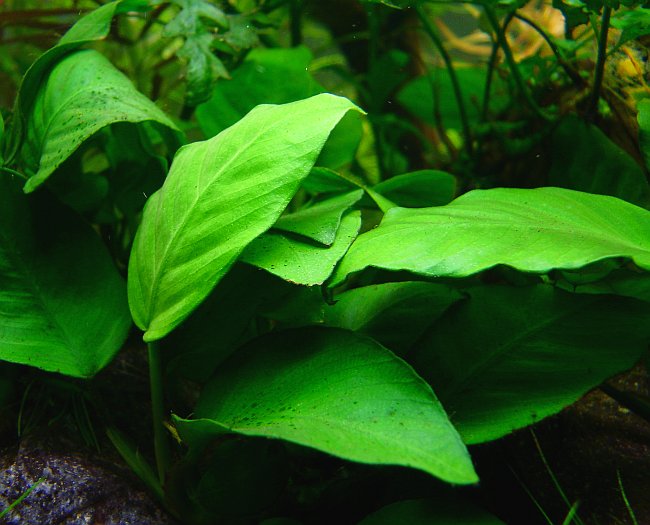
Anubias (Anubias barteri) is a marshy grass from West Africa, an epiphyte. Thick dark-green leaves, slow growth, individual leaf lifespan 3–5 years. The leathery texture and bitter taste make anubias unappealing to goldfish, cichlids and other plant-munchers. This is the №1 plant for tanks where normal plants get eaten within a week.
Cardinal rule — DO NOT bury
The rhizome must stay ABOVE the substrate. Buried, the rhizome rots in 2–4 weeks. The right way: tie it with fishing line or nylon thread to driftwood, rock or mangrove roots. In 2–3 months the roots fuse to the decor and the line can come off.
Light and CO₂
Anubias is a low- to medium-light plant: 0.2–0.4 W/L of 6500 K LED, 6–8 hours. Under high light without CO₂ leaves get green spot algae and black beard. With CO₂ it grows twice as fast, but it's overkill — anubias is plenty without it.
8 varieties
• Barteri var. nana — 10–15 cm, the most popular.
• Nana Petite — miniature, 3–5 cm, for nano tanks.
• Nana 'Pinto' — white-variegated leaves, premium price.
• Coffeefolia — wrinkled textured surface.
• Frazeri — long leaf up to 25 cm.
• Heterophylla — large solitary specimen up to 35 cm.
• Lanceolata — narrow long leaf.
• Hastifolia — arrow-leaf, dramatic background.
Propagation by division
When the rhizome reaches 15+ cm, split it with a sharp knife into 2–3 pieces so each has 3–5 leaves and roots. Seal the cut with aquarium silicone or dust it with activated carbon to prevent infection. Each piece is an independent plant, ready for the next division in a year.
Anubias outlives most aquarists. You buy it once and spend the next 10 years dividing and gifting it — the only plant that genuinely earns back its $5.
Problems
• Green spot algae — slow growth + too much light per leaf. Reduce lighting, add nerite snails.
• Black beard — excess organics and light. Water changes, shorter photoperiod.
• Yellowing and dropping leaves — iron or potassium deficiency. Liquid fertiliser (Tropica Specialised, Seachem Flourish).
• Rotten rhizome — buried in substrate. Pull it immediately, cut off the rotten section, tie to driftwood.
Comparison with other 'indestructible' plants — in our [no-CO₂ plants guide].
FAQ
- Does anubias flower?
- Yes, it periodically sends up a white spadix-like flower above the water. The flower has no scent, but it's an indirect confirmation that the plant is in great shape.
- Why isn't my anubias growing?
- That's normal. Growth rate is 1 new leaf every 1–2 months. If after six months not a single new leaf has appeared — iron or light deficiency.
- Can I keep it with a goldfish?
- Yes. Anubias is one of the 3–4 plants a goldfish won't eat (alongside Java fern, vallisneria and mosses). More in our [coldwater plants guide].

Goldie editorial team
Practising aquarists with a combined 30+ years of experience · Biologists and editors, fact-checking against FishBase and Seriously Fish · Every piece is reviewed by a qualified ichthyologist before publication

Senior aquarist, breeder, show judge
27+ years in aquaristics · Certified IAPLC judge (International Aquatic Plants Layout Contest) · Registered breeder of an Apistogramma agassizii line
Sources
- Tropica — Anubias barteri · Tropica · 2026-11-13
- Seriously Fish — Anubias · Seriously Fish · 2026-11-13
- Practical Fishkeeping — Anubias care · Practical Fishkeeping · 2026-11-13