Filters and aeration for aquariums of every size — the complete guide
How to size a filter to your tank, calculate turnover, pick the right type, and decide if you need extra aeration. From nano cubes to large biotopes.
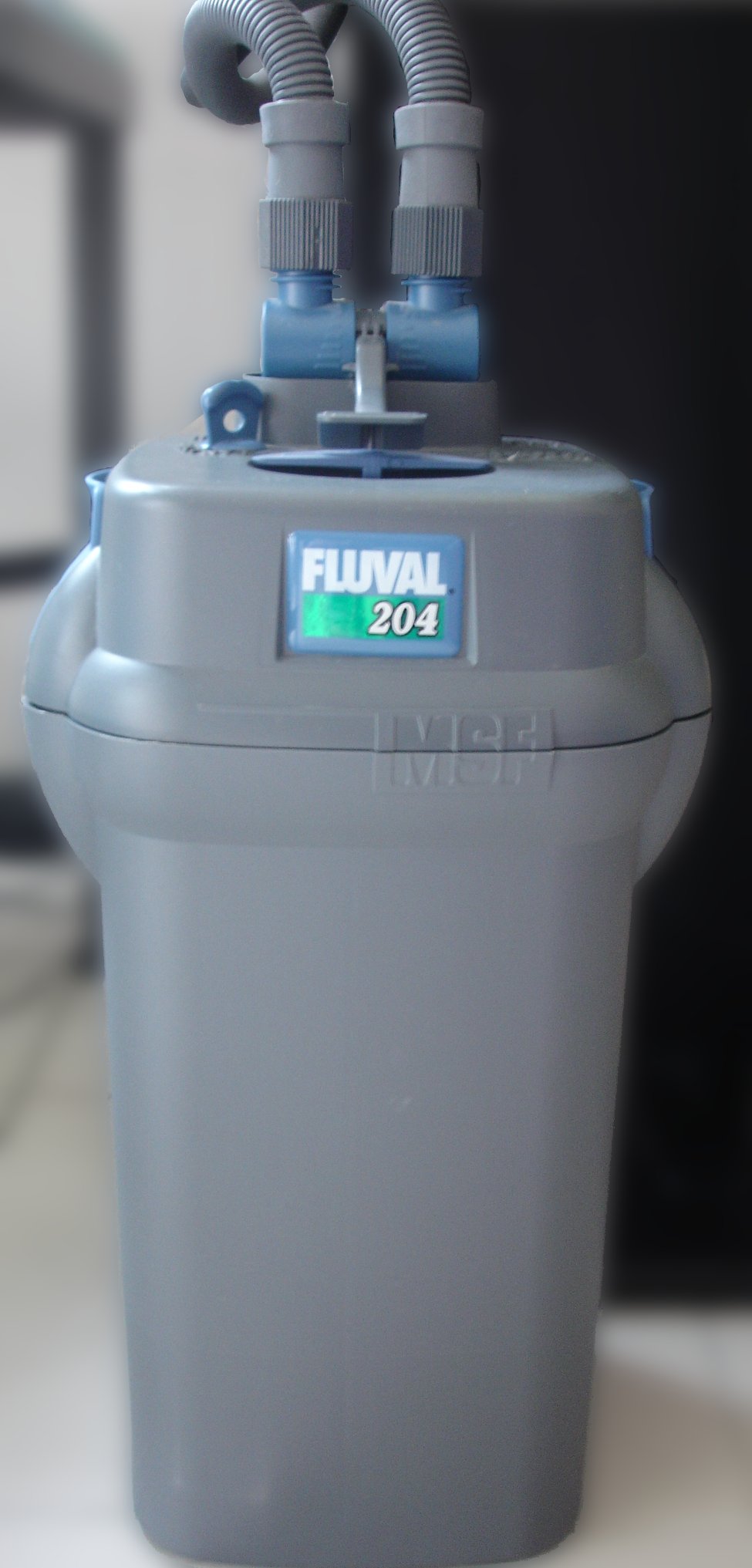
The filter is the heart of an aquarium. Without it, ammonia and nitrite from fish waste accumulate within days and kill everything alive. Aeration is the controversial part: in some tanks it saves lives, in others it's pointless and even hurts plants. This guide gives concrete numbers and setups for tanks from 5 to 130 US gallons (20 to 500 L) so you don't overpay or cut corners where you shouldn't.
Unlike the surface-level 'buy a filter twice your tank volume' advice, we break down the three filter jobs, turnover math with stocking corrections, and real-world scenarios — a 5-gallon shrimp tank, a 25-gallon community, a 65-gallon biotope, a 105-gallon cichlid setup.
Three jobs a filter does
Every aquarium filter performs one, two or three jobs at once. Knowing them helps you pick media intelligently rather than by what's prettiest on the shelf.
Mechanical filtration
Catches suspended particles — food crumbs, feces, plant debris. Makes the water visually clear. Handled by foam sponges of coarse and fine porosity, plus polishing floss. Rinse every 1–2 weeks in old tank water — never tap water, which would kill the bacteria.
Biological filtration
The main and irreplaceable job. Porous media (ceramic rings, bio-balls, lava rock, sintered glass) host nitrifying bacteria: Nitrosomonas turn ammonia into nitrite, Nitrospira/Nitrobacter turn nitrite into nitrate. Never rinse bio-media under the tap — chlorine wipes out the colony. Replace at most 30% per year, only if truly clogged.
Chemical filtration
Activated carbon, zeolite, ion-exchange resins. Removes dyes, medications, tannins, ammonia. This is a temporary fix: after a treatment course, when fresh driftwood tints the water, when starting a complex tank. Long-term carbon use is pointless — it exhausts in 3–4 weeks and just sits there as dead media.
Sizing: the turnover rule
Base formula: the filter should turn over 4–6 tank volumes per hour. A 25-gallon (95 L) tank wants 380–570 L/h. But that's net flow with full media; a real filter loses 20–40% of rated capacity within 2–3 months. So when shopping, look at 6–10 turnovers/hour on the spec sheet.
Stocking corrections:
• Lightly stocked planted tank — bottom end (4×); too much flow hurts plants.
• Mid-density community tank — 5–6×.
• Cichlids, goldfish, discus — 8–10×; these fish produce a lot of waste.
• Shrimp tank — 3–4×; shrimp get sucked into the intake; a sponge pre-filter is mandatory.
Nano tanks under 8 gallons (30 L)
Best pick — a sponge filter on an air lift. The principle: an air pump pushes air up a tube, the rising bubbles pull water through a sponge. You get a filter and an aerator in one. Pros: cheap ($5–15), safe for shrimp and fry, easy to maintain.
Alternative — a tiny internal filter rated 200–300 L/h. Set the flow regulator to minimum; otherwise a 5-gallon cube becomes a washing machine and fish can't rest. A canister on a nano is almost always overkill.
Small tanks 8–26 gallons (30–100 L)
Two viable options. An internal cartridge filter rated 400–600 L/h — classic, cheap ($20–50), simple. Downside: occupies internal space and ruins aquascape lines.
Hang-on-back (HOB) — clips to the rear glass, intake and return go into the water. Doesn't eat internal volume, easy to service without draining. Brands: AquaClear, Fluval, Tetra. Budget $50–100.
Mid-size tanks 26–53 gallons (100–200 L)
The boundary between internal and external. At 100–150 L a strong internal (700–1000 L/h) still works, but with demanding stocking or an aquascape, go canister from the start.
Canister filter — a sealed body under the tank, hoses to and from. Huge media volume, quiet operation, service every 2–3 months. Brands: Eheim Classic/Professionel, JBL CristalProfi, Fluval 07 series. Budget $120–250 for a 200-L unit.
Large tanks 53–130+ gallons (200–500+ L)
Canister-only or a sump (a separate technical tank below the display, standard in marine and large freshwater). Canisters: Eheim Professionel 4+, JBL e1902, Oase Biomaster Thermo (with built-in heater). Flow from 1500 L/h.
A sump gives unlimited media space and a hidden zone for the heater, CO₂ reactor, UV sterilizer. Downsides: complex build, sound of falling water, price. Worth doing from 300 L up and only with serious commitment.
Aeration: when needed, when harmful
Popular myth — 'every tank needs an air pump.' In reality, most freshwater tropical setups with normal filter flow and surface agitation have plenty of oxygen. Plants release O₂ during the day on top of that.
Aeration is required when:
• Heavy stocking or larger fish (10+ fish averaging 5 cm/2 inches per 100 L).
• Heatwaves above 28 °C (82 °F) — oxygen solubility drops sharply.
• Salt or methylene blue treatment — these reduce gas exchange.
• Labyrinth fish tanks (bettas, gouramis) — DO NOT add aeration; they need a calm surface.
Planted tanks with CO₂ injection run the air pump on a timer at night only: during the day it would blow off the CO₂; at night it compensates for the oxygen drop from plant respiration.
Maintenance
Simple and non-negotiable schedule. Every week, during the water change, rinse the mechanical sponge in the drained tank water (never tap water). Every 2–3 months, open the canister, inspect the impeller and gaskets, swap out carbon or polishing floss if used. Don't touch bio-media — it matures over a year and runs for a decade after.
Checklist by volume
• 10–30 L (2.5–8 gal): air-lift sponge filter 200–400 L/h + air pump.
• 30–100 L (8–26 gal): internal 400–600 L/h OR HOB 600–800 L/h.
• 100–200 L (26–53 gal): HOB 1000 L/h OR canister 800–1200 L/h.
• 200–400 L (53–105 gal): canister 1500–2000 L/h.
• 400+ L (105+ gal): canister 2000+ L/h OR sump.
The best filter is the one you actually service every week. An expensive canister you forgot to clean in six months loses to a cheap sponge that's rinsed on schedule.
Common beginner mistakes
• Buying a filter sized exactly to spec — real-world flow drops by 30%.
• Rinsing bio-media under the tap — kills the colony, cycle reboot for 4 weeks.
• Using carbon permanently — exhausts in a month, just sits as mechanical media after.
• No pre-filter on a shrimp tank — shrimp get sucked in, fry losses.
• Air pump 24/7 in a CO₂ planted tank — blows out the expensive gas within a week.
FAQ
- Can I run a small aquarium without a filter at all?
- Only in one scenario: a heavily planted tank with very low stocking and regular water changes. For everything else, a filter is mandatory — without biological filtration, ammonia kills fish in 2–4 days.
- Should I replace filter media completely?
- Never. Biological media is the foundation — replace at most 30% per year. Mechanical sponges are only swapped when they physically fall apart. Carbon is replaced every 3–4 weeks if you're using it.
- Internal or external filter — which is better?
- Under 100 L, internal or HOB is fine. Above 100 L, go canister — more media, quieter, easier service. Above 200 L, canister or sump only.
- Air pumps are noisy — is there a quiet one?
- Yes. Tetra APS, Eheim Air, and JBL ProSilent with rubber feet and quality diaphragms run nearly silent. Budget $5–10 models are always noisy.
- Can I switch the filter off at night?
- Absolutely not. The biofilter works only with constant water flow. Within 2–4 hours of no flow, bacteria start dying from oxygen starvation. By morning you get an ammonia spike.

Goldie editorial team
Practising aquarists with a combined 30+ years of experience · Biologists and editors, fact-checking against FishBase and Seriously Fish · Every piece is reviewed by a qualified ichthyologist before publication

PhD in aquatic biology, expert in the nitrogen cycle and water quality
PhD in aquatic biology, Humboldt University of Berlin · 15+ years of peer-reviewed publications on nitrification and microbial ecology · Co-author of the textbook 'Practical aquaculture and recirculating systems'
Sources
- Eheim — Filter media and turnover guide · Eheim · 2026-05-31
- Practical Fishkeeping — Choosing the right filter · Practical Fishkeeping · 2026-05-31
- Seriously Fish — Aquarium filtration basics · Seriously Fish · 2026-05-31
- FishBase · FishBase · 2026-05-31