Guppy (Poecilia reticulata): care, breeding and setup
The world's most popular beginner fish. Water parameters, sex ratio, feeding, runaway breeding and how to keep numbers under control.
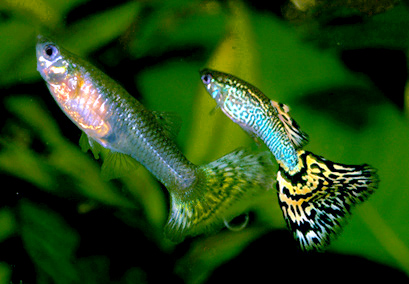
The guppy (Poecilia reticulata) is a livebearer from Venezuela, Trinidad and Guyana that entered the hobby in 1908 and has been bred into dozens of fancy strains since. Delta, ribbon, cobra, mosaic, tuxedo — colour patterns are endless. The perfect 'first aquarium' fish: hardy, colourful, eat anything, breed themselves. The one catch — without population control, 6 guppies become 60 within six months.
Tank size and water parameters
Minimum 38 L for a group of 6–8, optimum 60–80 L. Temperature 22–28 °C, pH 7.0–8.2, gH 8–20, kH 4–10. Guppies love hard alkaline water — the opposite of neons and most South American fish. Chlorine must be neutralised with conditioner. Aeration isn't needed if there's normal surface turbulence.
Sex ratio
Key rule: 1 male per 2–3 females. With more males, females get harassed constantly and stress themselves to death. If you want zero offspring — keep males only (they're brighter, no breeding). All males — no aggression problem, unlike bettas. All females — minimum drama, no bright colour.
Feeding
Guppies are omnivores. Base diet: premium flakes (TetraMin, JBL NovoBel) 1–2 times daily in small portions. Once a week — frozen brine shrimp, daphnia or bloodworms to boost colour and condition females. Vegetable supplement (blanched spinach or spirulina flakes) once a week. A fast day is mandatory — guppies are prone to obesity.
Breeding — effortless
Females are pregnant for 21–30 days. Pre-birth signs: dark gravid spot near the anal fin and a stretched belly. They drop 20–80 fry in one go, up to 200 in larger females. Fry swim and eat from minute one. With no removal, parents eat a chunk — in a densely planted tank (mosses, floating plants) 20–40% survive.
Want population control? Add 3–4 neons or panda corys — they eat fry and leave a 5–10% natural surplus. Want bulk breeding? Set a 10 L grow-out tank with plants, move the pregnant female in 2–3 days before birth, move her back out after.
Tankmates and diseases
Compatible: mollies, platies, neons, cardinals, corydoras, otocinclus, amano shrimp. NOT compatible: bettas (shred fins), tiger barbs (fin-nippers), angelfish (eat fry), any cichlids. Typical diseases: ich at low temperature, fin rot from poor water, fungus on the tail after fights. Details in our [diseases handbook].
The guppy is a textbook fish. If yours die, the problem isn't the guppy — it's the aquarium: check temperature, ammonia, nitrite and stocking density.
Lifespan
In shop conditions and poor water — 6–12 months. In a proper aquarium — 2–3 years, records up to 5. Fancy delta males live shorter — 1–1.5 years because of the cardiovascular load of a long tail. The wild form (Endler livebearer) — up to 3 years.
FAQ
- Can I keep a single guppy?
- Technically yes, but not recommended. Guppies are social — alone, they lose colour and activity. Minimum 3, ideally 6+.
- How many times a year does a female give birth?
- Up to 8 times back-to-back. She's ready for mating again right after birth, and she stores sperm for up to 6 months. A single inseminated female can produce broods for half a year on her own.
- What if I end up with too many?
- Rehome via local aquarium communities, sell back to the shop (many take returns), or let nature balance things: natural mortality and predation stabilise the population at 30–50 fish.

Goldie editorial team
Practising aquarists with a combined 30+ years of experience · Biologists and editors, fact-checking against FishBase and Seriously Fish · Every piece is reviewed by a qualified ichthyologist before publication

PhD in aquatic biology, expert in the nitrogen cycle and water quality
PhD in aquatic biology, Humboldt University of Berlin · 15+ years of peer-reviewed publications on nitrification and microbial ecology · Co-author of the textbook 'Practical aquaculture and recirculating systems'
Sources
- Seriously Fish — Poecilia reticulata · Seriously Fish · 2026-09-04
- FishBase — Poecilia reticulata · FishBase · 2026-09-04
- Practical Fishkeeping — Guppies · Practical Fishkeeping · 2026-09-04