Java fern (Microsorum pteropus): care, varieties and propagation
The most indestructible plant for a beginner aquarist. Grows without CO₂, without substrate, in any water. 5 common varieties, how to attach it and how to propagate it via plantlets.
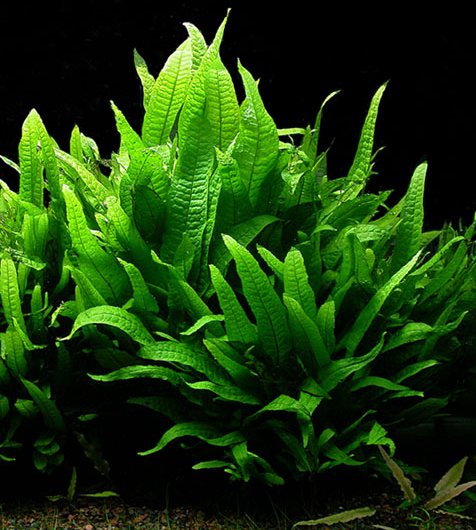
Java fern (Microsorum pteropus) has been the backbone of the hobby since people still believed plants eat through their roots. From Southeast Asia, an epiphyte — it grows on driftwood and rocks, not in the substrate. Takes any temperature 18–28 °C, any pH 5.5–8.0, survives even in dim light. If a beginner manages to kill this plant, the problem is serious.
Cardinal rule — DO NOT bury
The rhizome must stay ABOVE the surface, with roots in the decor, not the substrate. Bury the rhizome in gravel and it rots in 2–4 weeks; the plant dies. This is the №1 beginner mistake. Do it right: tie the rhizome to driftwood or rock with thin fishing line or nylon thread; in 2–3 months the roots fuse to the wood and you can remove the line.
Light and CO₂
Java fern is a low- to medium-light plant: 0.2–0.4 W/L of 6500 K LED, 6–8 hours daily. Under high light without CO₂ the leaves get black-beard algae and green spot. Without CO₂ — perfect. With CO₂ — twice the growth rate, but it's overkill for such an undemanding species.
5 main varieties
• Standard (M. pteropus) — 15–30 cm leaves, classic for the back wall.
• Narrow Leaf — 5 mm wide leaves, more elegant look.
• Windelov — leaves branch into a crown at the tips, very ornate.
• Trident — three 'fingers' along each leaf.
• Philippinen — large leaf with a wavy edge, up to 40 cm.
Propagation by plantlets
A unique feature: on old leaves tiny 'plantlets' with their own roots sprout along the edges. When a plantlet reaches 3–5 cm, gently detach it and tie to a fresh piece of wood. A month later — independent plant. From one mature mother bush you get 10–20 plantlets a year.
Alternative — split the rhizome in half with a sharp knife when it grows past 15 cm. Each half with its roots keeps growing independently.
Problems and fixes
• Black beard on leaves — too much light, not enough water changes. Drop light to 6 hours, raise changes to 30% weekly.
• Green spot — normal on a slow grower, only a problem if it spreads. Fix: nerite snails or bristlenose plecos.
• Transparent patches on the leaf — potassium deficiency. Liquid fertiliser like Tropica Specialised or Seachem Flourish.
• Old leaf browning from the centre — natural die-off every 6–12 months. Cut it off at the rhizome.
If you killed a Java fern, you buried the rhizome. Tie it to driftwood and forget about it for a year. A year later it'll look better than your friends' fanciest CO₂ tank.
Compatible tankmates
Perfect for cichlid tanks (even the most destructive ones — Java fern's bitter taste protects it), bettas, angelfish, goldfish. Shrimp and snails graze the rhizome happily, collecting biofilm. More compatible plants — in our [no-CO₂ plants guide].
FAQ
- How long does Java fern live?
- A perennial with no fixed lifespan. Individual leaves last 6–18 months and are replaced. A clump can grow on a single driftwood for 10+ years.
- Will it survive in cold water with goldfish?
- Yes. Java fern tolerates 18 °C without issue — one of the few tropical plants that suits goldfish tanks too. Goldfish don't eat it thanks to the bitter taste.
- Does it grow in brackish water?
- Up to 1.005 specific gravity (about 5 g/L salt) — yes. Full marine — no. Perfect for low-end brackish biotopes (glass shrimp, mollies in slightly salted water).

Goldie editorial team
Practising aquarists with a combined 30+ years of experience · Biologists and editors, fact-checking against FishBase and Seriously Fish · Every piece is reviewed by a qualified ichthyologist before publication

Aquascaper, IAPLC top-ranked finalist, specialist in Southeast Asian biotopes
Top-ranked IAPLC finalist (International Aquatic Plants Layout Contest) · 20+ years designing freshwater aquariums · Member of the Aquascaping Society of Japan
Sources
- Tropica — Microsorum pteropus · Tropica · 2026-10-02
- Seriously Fish — Java fern · Seriously Fish · 2026-10-02
- 2hr Aquarist — Epiphyte plants · 2hr Aquarist · 2026-10-02