Neon tetra (Paracheirodon innesi): care, setup and breeding
The world's №1 schooling fish for beginners and one of the trickiest to breed. Water parameters, school size, tankmates, neon tetra disease, blackwater spawning.
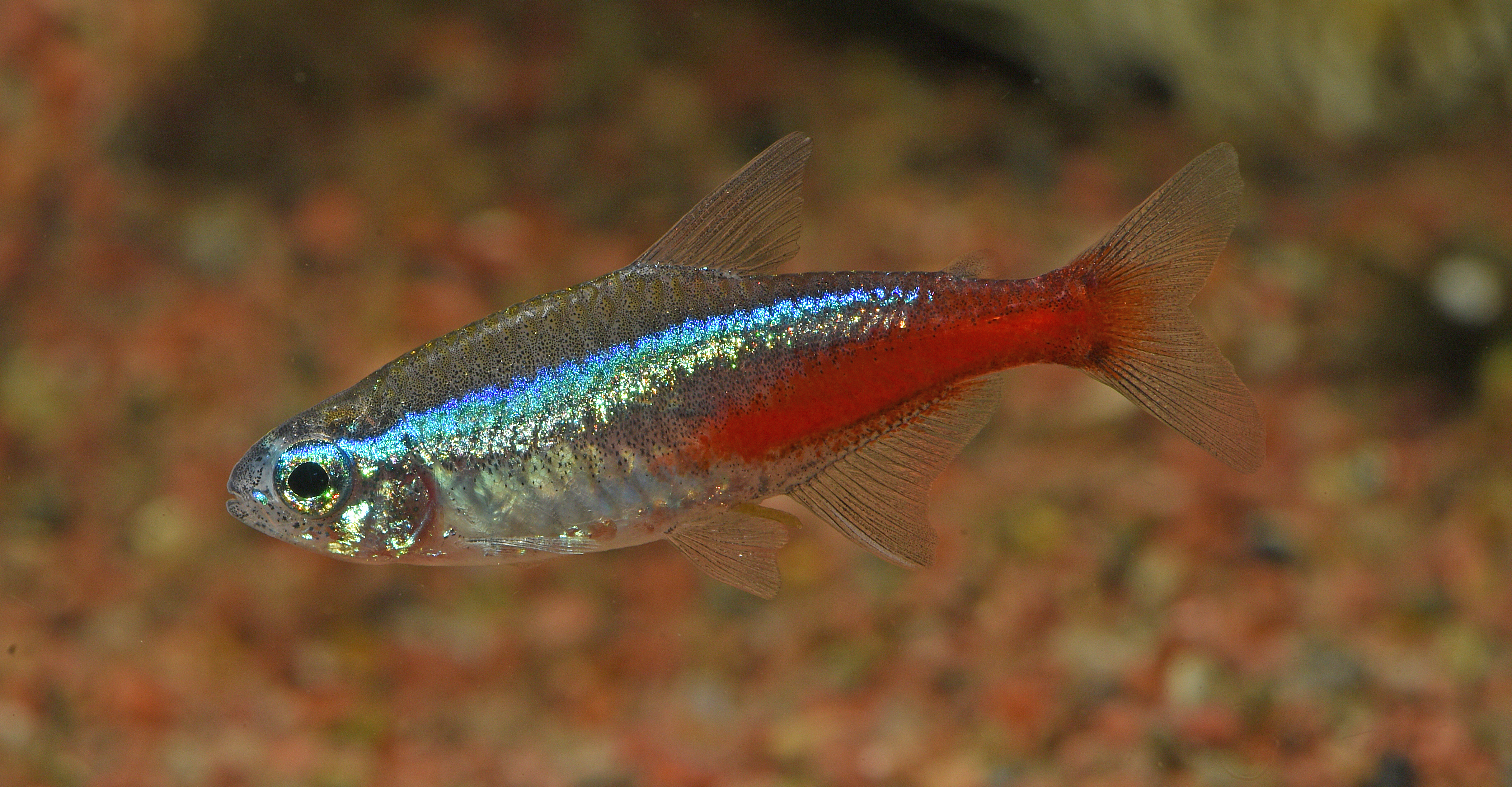
The neon tetra (Paracheirodon innesi) is the world's best-selling schooling fish and an iconic resident of the Amazon's blackwater tributaries. Bright blue stripe, red belly, peaceful temperament, small size — almost a perfect community fish. But under that simplicity sit real water requirements, school-size minimums and the threat of an incurable disease named after the species.
Water parameters
Native range — soft acidic water of the Rio Negro and other Amazon tributaries. Optimum: temperature 22–26 °C, pH 5.5–7.0, gH 1–8, kH 1–4. Modern stock from Czech and Malaysian farms tolerates more alkaline water, but they only breed in acidic parameters. pH 7.5+ and gH 12+ are survivable but produce dull colour and shorter lives.
Tank size and schooling
MINIMUM — a school of 6 in 38 L. Fewer than 6 and the fish hide in a corner, lose colour, get sick from stress. OPTIMUM — a school of 12–15 in 60–80 L: natural behaviour, tight schooling on disturbance. Length matters more than height — neons swim horizontally across the middle column.
Tankmates
Best matches: guppies, mollies, corydoras, otocinclus, peaceful dwarf cichlids (apistogramma, rams — in larger volume), amano shrimp (cherries will lose fry). NOT compatible: tiger barbs (fin nippers), bettas (aggression and stress on schooling fish), angelfish (adult angels eat young neons), Malawi cichlids. Full list in our [compatibility handbook].
Feeding
Premium flakes (TetraMin, JBL NovoBel) 1–2 times daily. Once a week — frozen brine shrimp, daphnia or cyclops for colour. Food must sink slowly — neons feed in the mid-column and won't pick from the bottom. A fast day once a week is mandatory; otherwise obesity and digestive issues follow.
Diseases and 'Neon Tetra Disease'
The dreaded one — Pleistophora hyphessobryconis, the 'Neon Tetra Disease' (NTD). Symptoms: colour loss in patches (pale grey spots), laboured swimming, separation from the school. INCURABLE; sick fish must be euthanised and removed, otherwise the rest get infected. The only protection is a 4-week quarantine for every new addition. Details in our [diseases handbook].
Other diseases: ich at low temperature, fin rot from poor water. Treated normally. Bacterial and fungal infections often mask late-stage NTD.
Breeding
Considered one of the hardest tetras to breed. You need a separate 20 L spawning tank with ultra-soft water (gH 1–2, kH 0, pH 5.5–6.0) made from RO water plus peat extract or alder cones. Temperature 24 °C. Subdued lighting (the classic trick is to wrap the sides with dark cloth). Substrate: a sponge mat on the bottom — eggs fall into it and are protected from the parents.
A pair of 1 male + 1 female spawns in the morning after 2 weeks of separate conditioning on live food. 50–150 eggs are laid; remove the parents immediately. Hatch in 24 hours. After 5 days fry start swimming and eat infusoria, then baby brine shrimp. The keys are sterile water and darkness — the eggs are photophobic.
A school of neons in correctly soft water is the most visually hypnotic thing in freshwater fishkeeping. In tap-water alkalinity they're just dull silver fish.
Lifespan
In optimal conditions — 5–8 years. In hard alkaline water — 2–3 years. A sign of stress from poor parameters: faded stripe, fish not staying with the school. For longevity and bright colour — soft water buffered with peat or Indian almond leaf.
FAQ
- How many neons make a school?
- Minimum 6, ideally 10–15. Fewer than that means stress and faded colour. A 38 L tank fits 10, a 60 L fits 15–20.
- Will neons survive in hard tap water?
- They'll survive but not in full health. Colour fades, lifespan drops from 5–8 to 2–3 years. With very hard water choose cardinals or rummynose tetras instead.
- What's the difference between neon and cardinal tetra (Paracheirodon axelrodi)?
- Size: neon 3 cm, cardinal 4–5 cm. Red stripe: in the neon it covers only the rear half, in the cardinal the whole belly. Same parameters. Cardinals are more resistant to NTD.

Goldie editorial team
Practising aquarists with a combined 30+ years of experience · Biologists and editors, fact-checking against FishBase and Seriously Fish · Every piece is reviewed by a qualified ichthyologist before publication

Aquascaper, IAPLC top-ranked finalist, specialist in Southeast Asian biotopes
Top-ranked IAPLC finalist (International Aquatic Plants Layout Contest) · 20+ years designing freshwater aquariums · Member of the Aquascaping Society of Japan
Sources
- Seriously Fish — Paracheirodon innesi · Seriously Fish · 2026-07-24
- FishBase — Paracheirodon innesi · FishBase · 2026-07-24
- Practical Fishkeeping — Neon Tetra Disease · Practical Fishkeeping · 2026-07-24