Nerite snails: the algae-cleaner that won't breed in freshwater
A unique snail: eats green, brown and diatom algae faster than any competitor and biologically cannot breed in freshwater. The perfect janitor for a community tank.
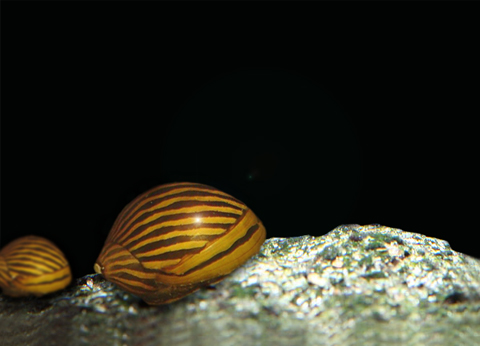
The nerite (Neritina spp., most often Neritina natalensis, N. cornuta, Vittina semiconica) is a native of tropical river mouths where fresh water meets sea. That quirk of life cycle made it the perfect aquarium snail: it eats algae three times faster than a bristlenose pleco and yet its eggs will never hatch in a regular freshwater tank — the larvae need brackish water.
What algae it eats
The nerite clears almost every film algae on glass, driftwood and plant leaves: green spot (Coleochaete), diatoms (soft brown film), hair algae and film cyanobacteria. It does NOT eat: black beard algae, marimo balls or anything suspended in the water. One nerite covers a 50 L tank a week.
Water parameters
Temperature 22–28 °C, pH 7.0–8.5 (important — soft acidic water erodes the shell and kills the snail in 3–6 months), gH 6–15, kH 4–10. Calcium is mandatory for shell growth — in soft water add a piece of coral or cuttlebone to the filter. The parameters are the opposite of what neons want: for an Amazon biotope the nerite is a poor pick; for hard European water it's perfect.
How many nerites per tank
Rule of thumb — 1 snail per 10–20 litres. Fewer and the algae get out of hand; more and the snails starve and start chewing on tender plant leaves. In a 38 L tank 2–3 nerites are enough. In a fish-free aquascape (plants + shrimp) go with 1–2 — there's less algae to begin with.
Tankmates
Compatible with practically every peaceful fish and invertebrate: guppies, neons, bettas, angelfish, cherry shrimp, amano shrimp. DANGEROUS for the nerite: clown loaches (crack shells), goonch catfish, rays, cichlids that dig snails out. Predatory snails (Helena) can attack young nerites. Shrimp the nerite ignores.
The famous 'egg problem'
In freshwater nerites regularly lay small white egg capsules on driftwood, rocks and glass. The capsules are tough, last for months and ruin the aesthetics. IMPORTANT: larvae develop inside them but never hatch — for fresh water it's a biological dead end. Scrape them off with a blade or an old credit card. Don't panic: breeding will never occur.
If you want pristine glass, keep a same-sex group (although nerites don't show obvious sex differences), reduce calcium to slow laying, or simply scrape regularly.
Varieties and prices
• Zebra nerite (Neritina natalensis 'zebra') — black-and-gold stripes, $4–6.
• Horned nerite (Clithon corona) — with spines, $5–8.
• Tiger nerite (Vittina semiconica) — orange with black spots, $5–7.
• Black helmet nerite (Neritina pulligera) — solid black, biggest of the lot at 3 cm, $4–7.
• Olive nerite (Vittina natalensis 'olive') — the cheap, basic model, $3–4.
The nerite is the only snail you can safely add to any aquarium without risking an outbreak. Multiply its efficiency by 30 and you understand why shrimp-keepers and aquascapers both adore it.
Care and lifespan
Lifespan is 1–3 years in freshwater (up to 5 in the wild). Supplementary feeding is rarely needed — tank algae are the bulk of the diet. When algae thin out in a mature tank, top them up with blanched spinach, zucchini or bottom-feeder tablets 1–2 times a week. More on alternative algae-control methods — in our [algae control guide].
FAQ
- Are nerite eggs really impossible to hatch?
- Biologically — yes. The veliger larvae need brackish water with at least 10% sea salinity. In freshwater they die at the planula stage. Confirmed by 30+ years of aquarium observation.
- Can I add nerites to a freshly set-up tank?
- Not recommended. Nerites need a mature film of diatoms and green algae. In the first 6–8 weeks the food supply is too thin and the snail starves. Add them after the first algae wave (usually 2–3 months from start).
- What if a nerite flips over and can't right itself?
- Gently turn it back over with your hand or a net. If it can't grip for 2–3 days it's likely sick or dying. A healthy nerite rights itself in 5–15 minutes.

Goldie editorial team
Practising aquarists with a combined 30+ years of experience · Biologists and editors, fact-checking against FishBase and Seriously Fish · Every piece is reviewed by a qualified ichthyologist before publication

Veterinary ichthyologist, specialist in aquarium fish diseases
DVM in veterinary medicine, University of Milan · PhD in hydrobiology, specialising in ornamental fish diseases · 10+ years of private veterinary practice with aquatic species
Sources
- Seriously Fish — Nerite species · Seriously Fish · 2026-08-21
- Practical Fishkeeping — Algae-eating snails · Practical Fishkeeping · 2026-08-21
- Aquatic Plants Central — Nerite life cycle · Aquatic Plants Central · 2026-08-21