Fish health
Diseases, prevention, quarantine, an aquarist's medicine cabinet.
 Deep-dive
Ich (White Spot Disease) in Aquarium Fish — Life Cycle, Heat and Medical Treatment
White spots on fish scales ('ich' or 'ick') indicate a lethal ciliated protozoan. We break down the life cycle of Ichthyophthirius multifiliis, differential diagnosis against Epistylis, heat therapy, and safe medication protocols.
 Deep-dive
Aquarium fish diseases — diagnostic algorithm and 8 key conditions
How to spot illness by behaviour and look, a four-step diagnostic protocol and treatment outlines for the 8 most common diagnoses: ich, velvet, columnaris, dropsy, swim bladder, saprolegnia, internal parasites, gill flukes.
 Deep-dive
Velvet disease (oodinium) in aquarium fish — symptoms, treatment, prognosis
Golden-grey 'dusty' coating on the skin, fast breathing, loss of appetite. A dangerous dinoflagellate parasite — treated with darkness, copper and heat. Without therapy, mortality in 3–7 days.
 Deep-dive
Columnaris in aquarium fish — telling it from fungus and treating it
A bacterial disease often mistaken for fungus. Greyish-white cotton-like patches on head and fins; the aggressive strain can kill in 24 hours. Treatment — antibiotics, lower temperature, salt.
 Deep-dive
Dropsy (pinecone) in fish — what it is, causes and odds of saving them
Raised scales, bloated belly, bulging eyes — not a disease in itself but a symptom of severe internal infection. Prognosis is grim: fewer than half survive even with correct treatment.
 Deep-dive
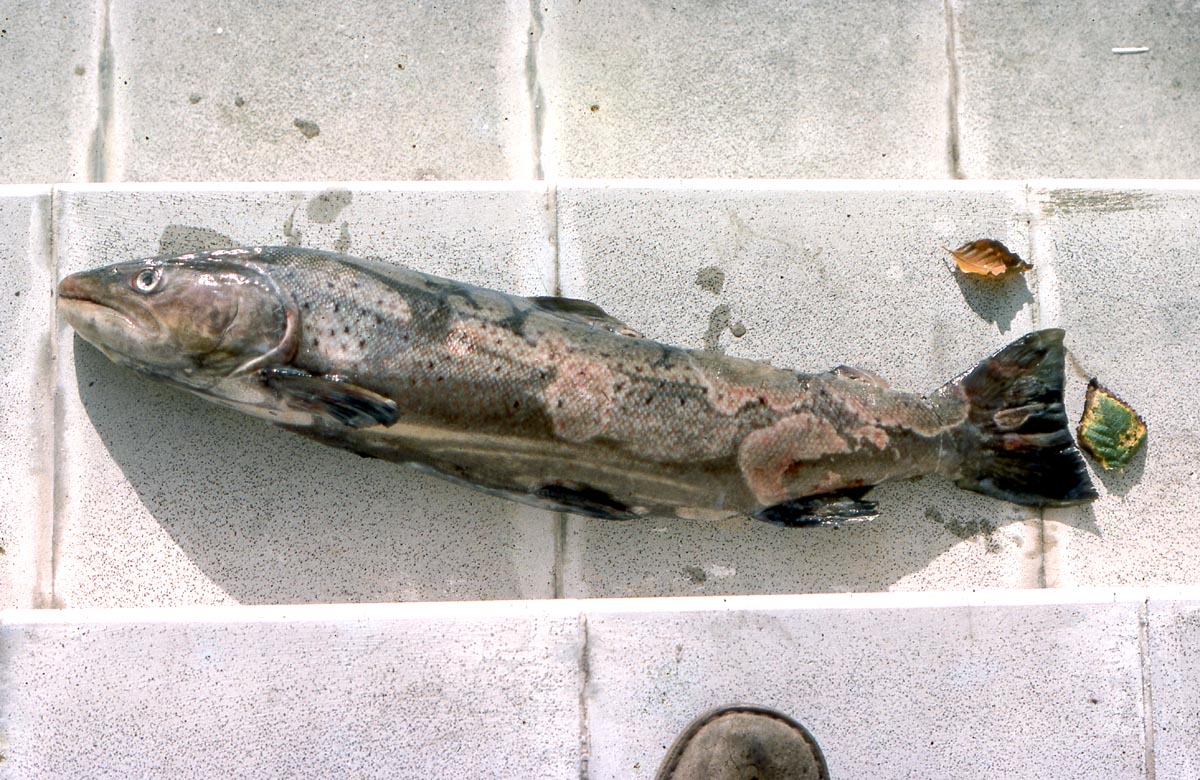
Swim bladder disorder — why your fish is swimming on its side
The fish floats belly-up, lies on its side, can't hold its position in the water. Causes range from simple constipation to bacterial infection and congenital deformity. A clear diagnostic and treatment plan.
 Deep-dive
Saprolegnia (fungus) on fish and eggs — treatment and root causes
White cotton-like tufts on wounds, fins or eggs. The fungus is an opportunist — it only attacks already-stressed fish. The key to treatment is removing the underlying cause (injury, bad water, stress); the fungus itself comes off easily with methylene blue.
 Deep-dive
Internal parasites in fish: Camallanus and Hexamita — diagnosis and treatment
Red worms protruding from the vent (Camallanus) or white stringy faeces and 'hole-in-the-head' in discus (Hexamita) — two different parasites needing different drugs: levamisole and metronidazole. Detailed treatment protocol.
 Deep-dive
Gill and skin flukes (Dactylogyrus, Gyrodactylus) — diagnosis and treatment
Microscopic flatworms on gills and skin. Symptoms — fast breathing, flashing, mucus clouding. Often present latently and flare up under stress. Treatment — praziquantel.
 Deep-dive
Fish mycobacteriosis (fish TB) — diagnosis, incurability and risk to humans
A chronic bacterial infection (Mycobacterium marinum, M. fortuitum) that's essentially untreatable. Progressive wasting, spinal curvature, ulcers. A dangerous zoonosis: humans get infected through skin wounds.
 Deep-dive
Fish hanging at the surface: 5 diagnoses
Almost always a red flag — except for a few species for which it's normal.
Deep-diveQuarantining new fish: a 4-week protocol
The most underrated routine in the hobby — it stops new fish from bringing disease into a mature tank.
Deep-diveFin Rot, Biting, or Tears? Real Reddit Cases, Pantyhose Test, and Safe Recovery
Blackened edges or overnight tears? We break down bacterial fin rot vs fin biting with real community photos, explain clear regrowth tissue, and detail the safe catappa protocol.
 Guide
GuideHospital tank: setup and use
When you can't dose the main tank with meds, you need a separate one. How to set it up, keep it ready, and not kill the patient.